Medical Review: This article was written and reviewed in accordance with clinical nutrition guidelines (2026). Evidence-based content.
The Energy Value of Macronutrients Explained
Every single time you consume food, you are ingesting chemical energy measured in calories (commonly referred to as kcal). If you have ever wondered how to utilize a calculator calories effectively, you must first comprehend how the foods you eat break down into the three primary macronutrients: proteins, carbohydrates, and fats. Each of these macronutrients plays a unique and essential role in physiological functions.
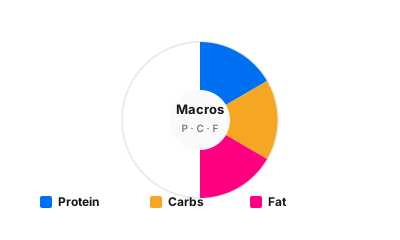
When evaluating dietary intake, it's paramount to look beyond just the total caloric value and consider the macro composition. For instance, consuming 100 calories of pure table sugar will have a vastly different metabolic impact compared to consuming 100 calories of lean chicken breast. The thermic effect of food (TEF), satiety signaling, and insulin response vary significantly among the different macronutrient profiles.
| Macronutrient | Calories per Gram | Primary Biological Role |
|---|---|---|
| Dietary Fats | 9 kcal | Long-term energy storage, hormone synthesis, cell membrane integrity |
| Proteins | 4 kcal | Muscle tissue repair, enzyme production, immune system support |
| Carbohydrates | 4 kcal | Primary rapid energy source, central nervous system fuel |
| Alcohol (Non-essential) | 7 kcal | Provides 'empty calories' without significant metabolic benefit |
| Fiber (Soluble) | ~2 kcal | Gut microbiome health, slow digestion, blood sugar regulation |
Optimize Your Nutrition with Our Cal Calculator
Do not leave your health and fitness results to chance. Utilize our advanced kcal calculator to precisely determine how much you need to eat based on your daily metabolic requirements and long-term objectives.
Ready to calculate your needs?
Use our free, science-backed calculator to find your exact calorie and macro targets.
Open Calorie CalculatorA Step-by-Step Guide to Calculating Your Macros
Now that you understand the caloric density of each macronutrient, the next phase is application. Balancing your macros efficiently ensures that you are providing your body with the optimal fuel mix for performance, recovery, and overall longevity. Follow these scientific steps:
Determine Your Total Daily Energy Expenditure (TDEE)
Use an official health calculator or our integrated tool to establish your TDEE. This represents the total number of calories your body burns in a 24-hour period, accounting for basal metabolic rate (BMR) and physical activity.
Establish Your Daily Protein Target
To preserve muscle mass, particularly in a caloric deficit, aim to consume between 1.6 and 2.2 grams of protein per kilogram of body weight. Because every gram provides 4 calories, you can easily calculate the caloric contribution of protein to your daily budget.
Allocate Your Dietary Fats
Dietary fats are vital for absorbing fat-soluble vitamins (A, D, E, and K) and regulating hormones like testosterone and estrogen. Reserve approximately 20-30% of your total calories for fats. Divide those specific calories by 9 to find out how many grams of fat you should consume daily.
Fill the Remaining Calories with Carbohydrates
Once protein and fat requirements are met, the remainder of your daily caloric budget is allocated to carbohydrates. Simply take the leftover calories and divide them by 4 to determine your target carbohydrate intake in grams. These carbs will fuel your workouts and daily mental tasks.
Frequently Asked Questions (FAQ)
How many calories are in a gram of fat?
There are approximately 9 calories in a single gram of fat. This high energy density makes dietary fats the most calorically dense macronutrient available. Fat molecules contain more carbon-hydrogen bonds than carbohydrates or proteins, which release a larger amount of energy upon oxidation in the human body.
How many calories are in a gram of protein?
There are approximately 4 calories in one gram of protein. Protein is crucial for muscle repair, enzymatic functions, and overall bodily maintenance. Moreover, protein boasts a high thermic effect (TEF), meaning your body actually burns a significant percentage of those calories just to digest and process the macronutrient.
How many calories are in a gram of carbohydrates?
Similar to protein, there are 4 calories in a gram of carbohydrates. Carbohydrates serve as the body's primary and most preferred energy source. Your brain and nervous system rely heavily on glucose, derived from carbs, to function optimally throughout the day.
How many calories are in a gram of alcohol?
There are 7 calories in a gram of alcohol. It is important to note that these are often considered "empty calories" because they provide raw energy but entirely lack vitamins, minerals, and overall nutritional value essential for health and fitness.
Why is it important to know how many calories are in a gram of food?
Understanding caloric density per gram helps you track your macros accurately, ensuring that you achieve a proper caloric deficit or surplus depending on your personal fitness goals. Being aware of the hidden calories in fats or alcohol can make the vital difference between hitting a plateau and seeing consistent results.
Does fiber contain calories?
Yes, but generally fewer than regular carbohydrates. While regular carbs have 4 kcal per gram, soluble fiber ferments in the gut and provides about 2 calories per gram. In contrast, insoluble fiber often passes directly through the digestive tract without contributing any significant caloric energy.
Suggested Content
Continue your journey in nutritional science and caloric tracking with our highly-rated educational resources.
How to Calculate Your Caloric Deficit
A comprehensive, science-backed guide to losing body fat sustainably and efficiently.
The Best Sources of High-Quality Protein
Discover which foods yield the highest amount of bioavailable protein per serving.