Expert Insight: The Psychology Behind the Frustration
Before we dive into the technical details, let's be incredibly honest for a moment. Navigating these guidelines can cause serious compliance fatigue. Whether you're trying to figure out the exact mathematical sizing for a perfect fit or dialing in complex daily metabolic metrics, the pressure to get it "exactly right" often leads to decision paralysis.
We hear from thousands of individuals who experience profound anxiety when their calculations don't perfectly align with reality. This is completely normal. Our biology and body measurements fluctuate naturally due to stress, hormonal changes, and daily physical activity. Striving for perfection often leads to burnout and abandonment of the goal entirely.
The Golden Rule: The experts advocate for the 80/20 principle. If your approach is 80% accurate consistently, you will mitigate long-term chronic issues—be it physical discomfort from poor structural support, or metabolic stalls from aggressive tracking. Use the data and the guides below as powerful baselines, but always grant yourself the grace to adjust based on how you actually feel in the real world. Your long-term well-being is vastly more important than temporary numerical perfection.
Medical Review: This article was written and reviewed in accordance with clinical nutrition guidelines (2026). Evidence-based content.
If you are relentlessly wondering "what is my TDEE?", you are targeting the foundational cornerstone of nutritional science and body recomposition. TDEE, or Total Daily Energy Expenditure, encapsulates the comprehensive sum of calories your biological system oxidizes throughout an entire 24-hour cycle. It serves as the most critical metric in weight management because it fundamentally represents your baseline maintenance calories. Once you precisely quantify this figure, you can engineer a dietary protocol to systematically lose fat, hypertrophy muscle tissue, or maintain your current physique with surgical precision.
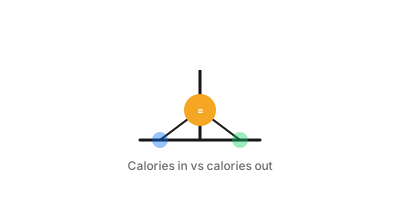
The laws of thermodynamics govern human metabolism. Energy can neither be created nor destroyed; it can only be transferred. When your caloric intake equates to your TDEE, you are in a state of energy balance (isocaloric). When intake is subordinate to TDEE, you enter a hypocaloric state (caloric deficit), mandating the oxidation of endogenous bodily tissues (ideally adipose fat) to synthesize the missing energy. Conversely, a hypercaloric state (caloric surplus) provides excess energy, facilitating the accretion of new tissue—muscle or fat.
The Four Pillars of TDEE Explained
Your Total Daily Energy Expenditure is not a monolithic entity; rather, it is a composite amalgamation of four distinct metabolic pathways. Understanding these distinct components is vital for manipulating your total daily burn.
- BMR (Basal Metabolic Rate): Comprising approximately 60-75% of your total TDEE, BMR represents the sheer physiological cost of existing. It is the caloric expenditure required to maintain cellular homeostasis, respiratory function, cardiac output, and neurological activity while entirely at rest.
- NEAT (Non-Exercise Activity Thermogenesis): This highly variable component accounts for 15-20% of TDEE. NEAT encapsulates all non-volitional and subconscious physical movement: pacing, fidgeting, maintaining posture, typing, and generalized daily ambulatory activities.
- TEF (Thermic Effect of Food): Representing about 10% of your daily energy expenditure, TEF is the caloric cost of masticating, digesting, absorbing, and assimilating dietary nutrients. Notably, protein demands the highest thermic tax (20-30% of its caloric value is burned during digestion), compared to carbohydrates (5-10%) and fats (0-3%).
- EAT (Exercise Activity Thermogenesis): Often heavily overestimated by the general populace, EAT typically comprises just 5-10% of total TDEE for non-athletes. This accounts for volitional, structured physical exertion such as weightlifting, running, or cycling.
Your TDEE is the mathematical summation of BMR + NEAT + TEF + EAT. A ubiquitous error is conflating BMR with TDEE. Remember: if your BMR calculates to 1,500 calories and you are moderately active, your authentic TDEE is approximately 1,500 × 1.55 = 2,325 calories. This final aggregate number is your physiological compass.
Step-by-Step Clinical Protocol for Calculating TDEE
Determine Your Basal Metabolic Rate (BMR)
Leverage the clinically validated Mifflin-St Jeor equation, widely regarded in nutritional epidemiology as a modern and reliable standard.
For Men: 10 × weight(kg) + 6.25 × height(cm) − 5 × age + 5.
For Women: 10 × weight(kg) + 6.25 × height(cm) − 5 × age − 161. Alternatively, our BMR instantly computes this metric.
Quantify Your Activity Multiplier Accurately
Maintain clinical objectivity; empirical data shows humans grossly overestimate their daily ambulation. If you occupy a sedentary desk job but attend the gymnasium thrice weekly, you are functionally "Lightly Active", not "Highly Active".
Apply the Mathematical Activity Factor
Multiply your calculated BMR by the corresponding activity quotient: Sedentary (1.2), Lightly Active (1.375), Moderately Active (1.55), Very Active (1.725), or Professional Athlete/Extremely Active (1.9).
Empirical Verification and Titration
The calculated TDEE is a robust estimation, not a thermodynamic law. Track your extrapolated TDEE intake for 14 to 21 days while recording median weekly body weight. If your weight is stable, the calculation is highly accurate. If you systematically gain weight, your TDEE was overestimated; reduce intake by 150-250 kcal and observe.
Real-World Clinical TDEE Case Studies
| User Biometrics | Estimated BMR | Activity Coefficient | Final TDEE Output |
|---|---|---|---|
| Female, 25 years, 165cm, 65kg | ~1,400 kcal | Moderate (1.55) | ~2,170 kcal |
| Male, 30 years, 180cm, 80kg | ~1,820 kcal | Moderate (1.55) | ~2,821 kcal |
| Female, 40 years, 170cm, 75kg | ~1,475 kcal | Light (1.375) | ~2,028 kcal |
| Male, 20 years, 175cm, 70kg | ~1,690 kcal | Very Active (1.725) | ~2,915 kcal |
TDEE for Fat Loss (Cutting)
To systematically catalyze adipose tissue reduction while preserving lean mass, implement a clinical deficit of 300-500 kcal below your precise TDEE. This magnitude ensures optimal endocrine function and prevents metabolic adaptation (adaptive thermogenesis) from crashing your metabolism.
Launch Caloric Deficit Calculator →TDEE for Hypertrophy (Bulking)
To synthesize new contractile myofibrillar tissue (muscle), establish a targeted surplus of 200-400 kcal above your TDEE. Pair this hypercaloric environment with progressive overload resistance training and optimal protein biosynthesis protocols.
Launch Macronutrient Calculator →TDEE for Equilibrium (Maintenance)
Maintaining your physiological stasis is an active, ongoing endeavor. Consume your exact calculated TDEE daily. Note that as your body composition gradually shifts, your TDEE will subtly morph, requiring periodic clinical recalibration.
Read the Comprehensive Maintenance Guide →Quantify Your Exact Metabolic Output Today
The most scientifically rigorous and expedited method to unequivocally answer "what is my TDEE?" is by utilizing our clinical-grade computational tool. It integrates the most robust anthropometric algorithms available, assesses your idiosyncratic activity biomarkers, and outputs precise macronutrient targets in absolute milliseconds.
Ready to calculate your needs?
Use our free, science-backed calculator to find your exact calorie and macro targets.
Open Calorie CalculatorSources and further reading
These independent, authoritative sources inform the methods used on this page.
Curated Scientific Literature
The Definitive Guide to Caloric Deficits
Explore evidence-based protocols to sustain a clinical calorie deficit while mitigating psychological fatigue, mitigating muscle catabolism, and avoiding ubiquitous dietary pitfalls.
The Science of Caloric Surpluses
Master the biological mechanisms of the 'lean-bulk', an advanced nutritional framework designed to maximize muscular hypertrophy while severely curtailing concurrent lipogenesis (fat accumulation).