Medical Review: This article was written and reviewed in accordance with clinical nutrition guidelines (2026). Evidence-based content.
The Big Three Numbers
- Protein: 4 calories per gram
- Carbohydrates: 4 calories per gram
- Fat: 9 calories per gram
Calories Per Gram: The Universal Truth
Protein = 4 kcal/g | Carbs = 4 kcal/g | Fat = 9 kcal/g
This is not an approximation — it's the Atwater system, established through controlled scientific bomb calorimetry testing. When these macronutrients burn, each releases a predictable amount of energy.
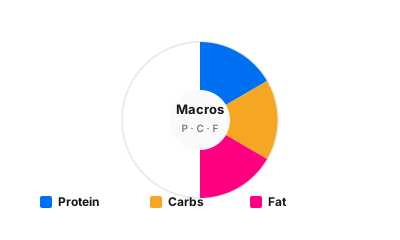
Quick Facts Everyone Should Know
| Macro | Calories/gram | Formula | Example (100g) |
|---|---|---|---|
| Protein | 4 kcal | Grams × 4 | 400 kcal |
| Carbs | 4 kcal | Grams × 4 | 400 kcal |
| Fat | 9 kcal | Grams × 9 | 900 kcal |
The Complete Macro Calorie Chart
Quick conversion table for common macro amounts:
| Grams | Protein (kcal) | Carbs (kcal) | Fat (kcal) | Total (all protein) |
|---|---|---|---|---|
| 10g | 40 kcal | 40 kcal | 90 kcal | 40 kcal |
| 25g | 100 kcal | 100 kcal | 225 kcal | 100 kcal |
| 50g | 200 kcal | 200 kcal | 450 kcal | 200 kcal |
| 75g | 300 kcal | 300 kcal | 675 kcal | 300 kcal |
| 100g | 400 kcal | 400 kcal | 900 kcal | 400 kcal |
| 150g | 600 kcal | 600 kcal | 1350 kcal | 600 kcal |
| 200g | 800 kcal | 800 kcal | 1800 kcal | 800 kcal |
How to Calculate Calories From Macros
The formula is simple multiplication:
Protein calories
Grams × 4
Example: 150g × 4 = 600 kcal
Carbs calories
Grams × 4
Example: 200g × 4 = 800 kcal
Fat calories
Grams × 9
Example: 67g × 9 = 603 kcal
Complete Macro to Calories Formula
Total calories = (Protein g × 4) + (Carbs g × 4) + (Fat g × 9)
Example: 150g protein + 200g carbs + 67g fat = (150×4) + (200×4) + (67×9) = 600 + 800 + 603 = 2003 total calories
Grams to Calories Conversion
Knowing these formulas helps you track accurately:
Forward Conversion (Grams → Calories)
| Protein (g) | Calories | Reverse (Calories ÷ 4) | Grams |
|---|---|---|---|
| 25 | 100 kcal | 100 kcal ÷ 4 | 25g |
| 50 | 200 kcal | 200 kcal ÷ 4 | 50g |
| 100 | 400 kcal | 400 kcal ÷ 4 | 100g |
| 150 | 600 kcal | 600 kcal ÷ 4 | 150g |
| 200 | 800 kcal | 800 kcal ÷ 4 | 200g |
Protein Calories: The Science Behind 4 kcal/g
Why approximately 4 calories per gram?
In the late 1800s, Wilbur Olin Atwater developed the system still used today. He burned foods in a sealed chamber, measuring heat released. Protein averaged 4 kcal/g due to its nitrogen content and carbon-hydrogen bonds.
Does Cooking Change Protein Calories?
No. Cooking changes weight through water loss but not calories. 100g raw chicken (23g protein) vs 100g cooked chicken (31g protein) both metabolize to the same 4 kcal/g.
Protein vs Carbs vs Fat: Calorie Density Comparison
While protein and carbs share the same calorie density, their metabolic effects differ significantly:
| Metric | Protein | Carbs | Fat |
|---|---|---|---|
| Calories per gram | 4 kcal | 4 kcal | 9 kcal |
| Thermic effect | 20–30% | 5–10% | 0–3% |
| Satiety score | Highest | Moderate | Moderate |
| Muscle preservation | Essential | Not significant | Not significant |
| Energy storage | Amino acids | Glycogen (limited) | Adipose tissue |
Practical Applications
Putting macro calorie knowledge to work:
Tracking Your Intake
If you eat: 150g protein, 200g carbs, 67g fat
- Protein calories: 150 × 4 = 600 kcal
- Carb calories: 200 × 4 = 800 kcal
- Fat calories: 67 × 9 = 603 kcal
- Total: 2003 kcal
- Protein percentage: (600 ÷ 2003) × 100 = 30%
Adjusting Your Macro Split
To increase protein to 35% on 2000 calories:
- 35% of 2000 = 700 protein calories
- 700 ÷ 4 = 175g protein
- Remaining 1300 calories split between carbs and fat
Real-World Food Examples
See macro calories in action with common foods:
| Food | Serving | Protein | Carbs | Fat | Total |
|---|---|---|---|---|---|
| Chicken breast | 4 oz (113g) | 31g (124 kcal) | 0g (0 kcal) | 3g (27 kcal) | 151 kcal |
| Banana | 1 medium (118g) | 1g (4 kcal) | 27g (108 kcal) | 0g (0 kcal) | 112 kcal |
| Almonds | 1 oz (28g) | 6g (24 kcal) | 6g (24 kcal) | 14g (126 kcal) | 174 kcal |
| Greek yogurt | 1 cup (245g) | 20g (80 kcal) | 9g (36 kcal) | 0g (0 kcal) | 116 kcal |
| Olive oil | 1 tbsp (14g) | 0g (0 kcal) | 0g (0 kcal) | 14g (126 kcal) | 126 kcal |
Tools to Make It Easier
Protein Calculator
Find your daily protein target in grams and calories.
Calorie Calculator
Convert total calories to protein, carbs, and fat grams.
Continue Learning
- Protein Calculator — Your daily protein target
- Calorie Calculator — All macros with calories
- Protein Guide — Complete protein reference
Ready to calculate your needs?
Use our free, science-backed calculator to find your exact calorie and macro targets.
Open Calorie CalculatorMedical & Scientific References
- World Health Organization (WHO) - Healthy Diet
- Mayo Clinic - Counting Calories
- National Institutes of Health (NIH) - Weight Management
Expert FAQs & Psychological Impact
Let's be incredibly honest for a moment: dealing with this can cause serious compliance fatigue and anxiety. You are not alone. Here are the most critical, edge-case questions answered with complete transparency to protect your well-being and ensure you have all the facts.
1. How do I manage the anxiety around getting this exactly right?
The psychological burden of trying to be perfect can lead to decision paralysis. Experts recommend focusing on the 80/20 rule. Whether it's nutrition or sizing, consistency and general accuracy will yield 90% of your desired results. Do not let minor fluctuations disrupt your peace of mind.
2. What are the long-term effects of ignoring these guidelines?
Over time, systemic neglect cascades into larger physical and mental health issues. Proper adherence mitigates chronic discomfort and sets a baseline for sustainable lifestyle improvements. The goal is to build a foundation that supports you passively.
3. How often should I re-evaluate my baseline numbers?
Your body and circumstances are not static. It is highly recommended to reassess your measurements and caloric needs every 3 to 6 months, or immediately following any significant lifestyle or weight change. Proactive adjustments prevent reactive stress.
4. Is there a danger in relying entirely on automated calculators?
While calculators provide a mathematically sound starting point, they cannot account for nuanced human biology. Stress, sleep, and hormonal variations play a massive role. Always use calculator outputs as a guide, not gospel, and adjust based on real-world feedback from your own body.