A Lean Body Mass calculator estimates fat-free mass in your body. This impacts metabolism and is crucial during weight loss or muscle building.
What is lean body mass?
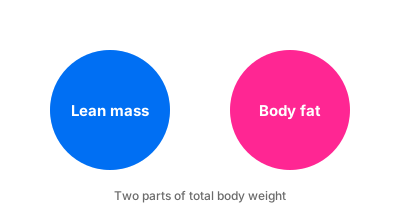
Lean body mass is your total body weight minus fat mass. It covers muscle, bones, organs, blood, connective tissue, and body water. Because lean tissue is metabolically active, a higher LBM raises your basal metabolic rate. Someone with a lot of muscle may burn hundreds more calories at rest than a lighter person with more fat.
Lean Body Mass formulas
Boer formula (predicts maximum potential):
| Sex | Formula |
|---|---|
| Men | LBM = 0.407 × weight + 0.267 × height - 19.2 |
| Women | LBM = 0.252 × weight + 0.473 × height - 48.3 |
Both weight and height in kg/cm. Our LBM calculator uses this. The Boer formula was designed to normalise body fluid volumes and is widely validated for general populations.
Fat-based Lean Body Mass calculation
If you know your body fat percentage from the body fat calculator:
LBM = weight × (1 - body fat percentage)
Example: 80 kg person, 15% body fat = 80 × 0.85 = 68 kg LBM
This method reflects actual body composition today, while the Boer formula estimates an upper potential.
Lean Body Mass ranges by demographics
| Group | Typical LBM % of weight |
|---|---|
| Men, average | 78–85% |
| Women, average | 70–77% |
| Men, athletic | 80–88% |
| Women, athletic | 72–80% |
How to use LBM in nutrition planning
Many coaches set protein relative to LBM rather than total body weight. This is especially useful if you carry extra body fat, because eating enough for your full weight may overshoot on calories. A common guideline is 1.6–2.2 g of protein per kg of lean body mass. Use the protein calculator to convert your target to grams, and the macro calculator to build a full meal plan.
Why Lean Body Mass matters for calories
- Metabolism: Each kg of LBM adds 15–25 calories to maintenance
- Strength: Higher LBM = more functional power
- Health: Better glucose control, bone density
- Aging: Preserving LBM prevents sarcopenia
Lean Body Mass and BMR connection
Estimated BMR contribution of LBM:
| LBM (kg) | Estimated BMR boost |
|---|---|
| 50 kg | ~750 calories/day |
| 60 kg | ~900 calories/day |
| 70 kg | ~1,050 calories/day |
| 80 kg | ~1,200 calories/day |
Use our BMR calculator for your total.
Maximizing Lean Body Mass
Strategies to increase LBM:
- Resistance training: Progressive overload builds muscle
- Adequate protein: 1.6–2.2 g/kg daily using protein calculator
- Surplus calories: Small surplus for muscle gain with TDEE calculator
- Sleep/recovery: 7–9 hours supports muscle synthesis
Related tools
Lean Body Mass Calculator
Estimate your LBM with the Boer formula.
Body Fat Calculator
Find your body fat percentage to compare with LBM.
Sources and further reading
These independent, authoritative sources inform the methods used on this page.