A maintenance calorie calculator tells you precisely how many calories you can eat each day without losing or gaining weight. This number — also called your TDEE (Total Daily Energy Expenditure) — is the cornerstone of any nutrition plan, whether your goal is fat loss, muscle gain, or weight maintenance.
Why maintenance calories are the foundation of nutrition
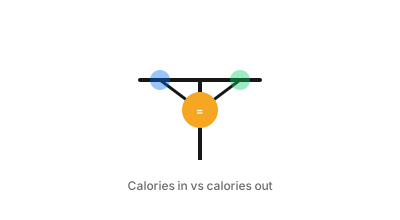
Every effective diet starts with knowing your maintenance calories. This is your baseline: eat at this level and your weight stays stable. Eat below it and you lose weight; eat above it and you gain. Without this number, you're guessing — and guesses lead to frustration and stalled progress.
The science behind maintenance calorie calculation
Your maintenance calories consist of three main components:
- BMR (Basal Metabolic Rate): 60–70% of calories burned, even at complete rest
- TEF (Thermic Effect of Food): ~10% of calories burned digesting meals
- Activity EE: 15–30% from daily movement and exercise
How the maintenance calorie calculator works
The calculator uses the Mifflin-St Jeor equation — the most accurate predictive formula for the general population. This equation considers:
| Factor | Impact on maintenance calories |
|---|---|
| Age | Decreases ~100 calories per decade after 25 |
| Sex | Men typically need ~200–400 more calories than women of similar size |
| Height | Taller people burn more calories due to larger organ mass |
| Weight | Higher weight = higher maintenance; lose ~10–20 calories per kg lost |
| Activity | Can vary maintenance by 500–1,000+ calories depending on level |
Step-by-step: How to use a maintenance calorie calculator
- Enter your age: Be accurate to the year for best results
- Select your sex: Required for the Mifflin-St Jeor equation
- Input your height: Use cm or feet/inches (we convert automatically)
- Enter your weight: Use current weight in kg or lbs
- Choose activity level: Be honest — most people overestimate
- Calculate: Your TDEE is your maintenance calorie target
Maintenance calorie examples by profile
| Profile | BMR | Maintenance (Moderate) | Maintenance (High) |
|---|---|---|---|
| Woman: 25, 165cm, 65kg | ~1,400 | ~2,170 | ~2,500 |
| Man: 30, 180cm, 80kg | ~1,820 | ~2,810 | ~3,200 |
| Woman: 40, 170cm, 75kg | ~1,475 | ~2,290 | ~2,660 |
| Man: 20, 175cm, 70kg | ~1,690 | ~2,590 | ~2,950 |
Using maintenance calories for weight loss
To lose weight safely and sustainably, subtract 250–500 calories from your maintenance level. This creates a moderate deficit that yields:
- ~0.5 lb (0.25 kg) per week with a 250-calorie deficit
- ~1 lb (0.5 kg) per week with a 500-calorie deficit
- ~2 lb (1 kg) per week with a 1,000-calorie deficit (extreme, not recommended long-term)
Use our calorie calculator to get goal-based targets automatically, or read the calorie deficit guide for a detailed approach.
Using maintenance calories for muscle gain
To build muscle, add 250–500 calories above maintenance. This provides energy for muscle protein synthesis without excessive fat gain. Pair with resistance training and adequate protein (1.6–2.2g per kg) for optimal results. Read our protein calculator guide.
Adjusting maintenance calories over time
Your maintenance calories change as you lose or gain weight. Recalculate every 4–5 kg (about 10 lb) of body weight change. When losing weight, maintenance drops by ~10–20 calories per kg lost. When gaining, it increases by ~10–15 calories per kg gained.
Activity level selection guide
Choosing the wrong activity level is the #1 cause of incorrect maintenance calorie estimates:
| Activity Level | Description | Activity Multiplier |
|---|---|---|
| Sedentary | Desk job, little/no exercise | 1.2 |
| Lightly Active | 1–3 workouts/week | 1.375 |
| Moderately Active | 3–5 workouts/week | 1.55 |
| Very Active | 6–7 workouts/week | 1.725 |
| Extra Active | Athlete + physical job | 1.9 |
Common maintenance calorie mistakes
- Overestimating activity level — leads to eating above true maintenance
- Not tracking intake accurately — food scales are essential
- Ignoring metabolic adaptation — weight loss slows maintenance needs
- Using outdated equations — Mifflin-St Jeor beats Harris-Benedict for accuracy