Your BMI calculator result places weight on a standardized scale. BMI = weight (kg) ÷ height (m)². Our calculator does this automatically.
BMI formula
BMI = weight(kg) ÷ height(m)²
Example: 80 kg person, 180 cm tall:
180 cm = 1.8 m
BMI = 80 ÷ (1.8 × 1.8) = 80 ÷ 3.24 = 24.7 (normal range)
BMI categories and health risks
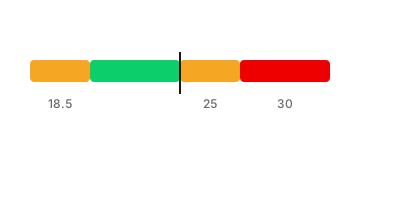
| BMI Range | Category | Health risk |
|---|---|---|
| < 18.5 | Underweight | Increased risk of nutrient deficiency, osteoporosis |
| 18.5–24.9 | Normal weight | Lowest risk for chronic disease |
| 25–29.9 | Overweight | Moderate increase in diabetes, heart disease |
| 30–34.9 | Obese class I | High risk of metabolic issues |
| 35–39.9 | Obese class II | Very high health risks |
| > 40 | Obese class III | Extreme health risks |
BMI limitations
BMI cannot:
- Distinguish muscle from fat
- Account for fat distribution
- Reflect fitness or metabolic health
- Apply accurately to athletes or elderly
For better assessment, use our body fat calculator or lean body mass calculator.
BMI and basal metabolic rate
BMI correlates with metabolic health but doesn't equal BMR. Muscle increases metabolism even if BMI is high. Use TDEE calculator for calorie targets.
BMI calculators vs manual calculation
Our BMI calculator offers advantages:
- Automatic unit conversion (cm/lbs to metric)
- Instant category classification
- Links to related calculators
- No mental math required
When to use BMI
BMI is a screening tool, not a diagnostic. Best for:
- Initial weight assessment
- Population health studies
- Tracking trends over time
- Insurance/health requirements